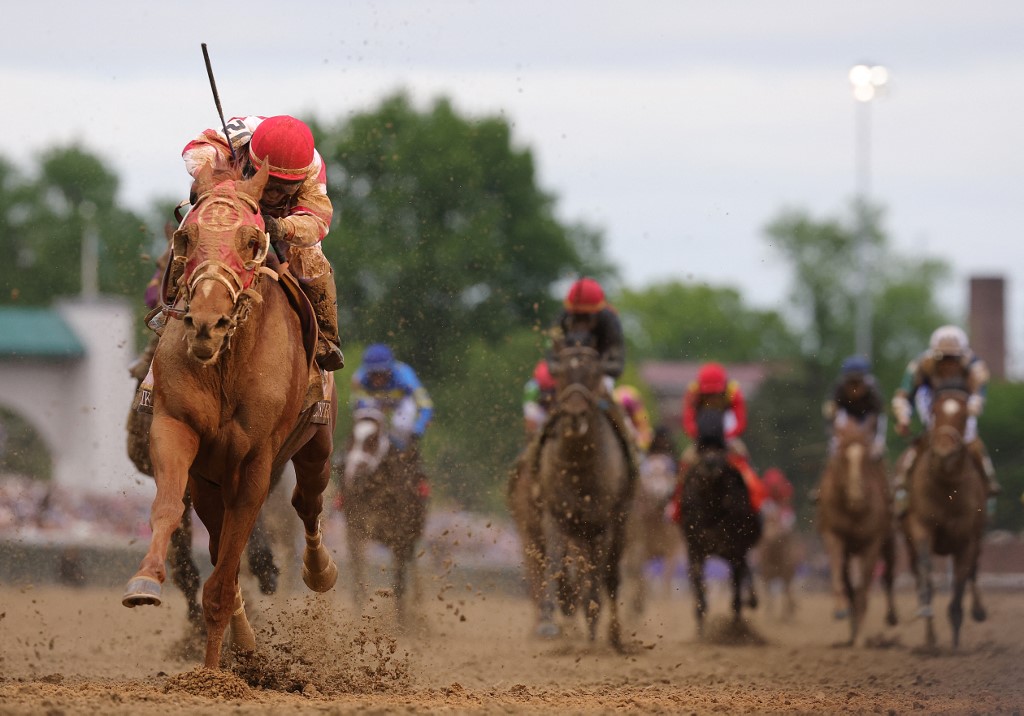
The Kentucky Derby is one of the most exciting events on the annual sports calendar. Every year on the first Saturday in May, as many as 20 horses emerge from the gates and race 1.25 miles around the dirt track at Churchill Downs. It takes roughly two minutes to determine a winner, and it’s anyone’s guess who will emerge victorious.
That unpredictability is part of what makes betting on the Kentucky Derby so appealing. Triple Crown winners are fun to predict in advance, but the real value is in calling the longshot that pulls off the shocking victory.
For every unbeatable legend of the track, there’s a horse that’s built its legend out of being the one that no one saw coming. That’s what we’re here to discuss: The biggest longshot winners in Kentucky Derby history. If you want to bet on a Kentucky Derby longshot this year, check out the most trusted offshore sportsbooks.
There are some massive longshots in this year’s race, too. Who’s to say we can’t add another to the ranks of the all-time upsets at Churchill Downs in 2026?
Longshots vs. Upsets
First, let’s break down the distinction between longshot winners and standard upsets. There’s a significant difference between the two.
An upset is a race in which the favorite does not win. And while this is somewhat surprising and unpredictable, it’s not inherently shocking. Upsets can be more marginal: A second- or third-ranked horse could defeat the favorite. That’s noteworthy, but it’s not something for the history books.
A longshot winning the race is more of a monumental event. These are the horses that are on the fringe of competing. The ones that don’t get much attention going into the Kentucky Derby. Sometimes, things break precisely in their favor, and sports bettors who saw it coming ahead of time score a huge payout.
Before discussing this year’s longshots, let’s take a look at the top five most improbable winners in the race’s storied history.
Giacomo: 50-1 (2005)
Giacomo led one of the all-time great comebacks in his shocking win at the 2005 Kentucky Derby. He was slow out of the gate and remained near the back of the field for more than half of the race, and by the time the leaders reached three-quarters of a mile, he was still in 18th place.
Jockey Mike Smith rode Giacomo to the outside, where he began to make up ground. Around the final turn, Giacomo found a seam and started to push through, closing in on a tight pack of leaders. Continuing on the outside, Giacomo surged ahead and made a final sprint for the finish line, winning by a half a length to secure the $1.6 million purse.
What’s ironic about Giacomo’s victory is that the 2005 Kentucky Derby nearly produced an even larger longshot victory. Closing Argument, who Giacomo passed in the final seconds, had 72-1 odds to win and was the biggest underdog on the board. Afleet Alex, the second-largest favorite, came in third at one length behind Giacomo.
A $1 superfecta on the exact order of the top four finishers paid over $860,000.
Mine That Bird: 50-1 (2009)
Four years after Giacomo’s stunning win, Mine That Bird delivered another upset at equal 50-1 odds.
Like Giacomo, Mine That Bird got off to a slow start. After falling behind out of the gate, he failed to make up ground and sat in last place through the first three-quarters of a mile. At times, Mine That Bird wasn’t even in view on the main broadcast feed.
Somewhere along the way, Mine That Bird found a second wind and, hugging the inside rail, began cruising back into position. Suddenly, he was overtaking every horse in front of him and making a real push for the front of the pack, though he was running out of room to make a move with every stride.
Despite sitting in 10th place after coming around the final turn, Mine That Bird made a strong sprint to the finish and left nothing up to chance. He won by nearly seven lengths, leaving every horse in the dust.
A $1 superfecta on the top four finishers of the 135th Kentucky Derby paid nearly $280,000.
Country House: 65-1 (2019)
The 2019 Kentucky Derby is still marred by controversy. To date, it’s the only race in the Derby’s history in which a winning horse was disqualified for on-track interference. The decision gave the victory to the second-place finisher, and as such, delivered the third-largest longshot win at 65-1 odds.
The race was won by Maximum Security, the second favorite at 9-2 odds. He was in control for much of the race and ultimately pulled away from the crowd before crossing the finish line. However, an objection was made shortly after the end of the race that Maximum Security had made illegal contact with another horse.
Upon review, it was determined that Maximum Security went out of his lane and interfered with War of Will, and the horse was disqualified.
Over $165 million was wagered on the 2019 Kentucky Derby. A $1 Super High Five on the top five finishers paid over $544,000.
Rich Strike: 80-1 (2022)
This remains the biggest longshot victory at the Kentucky Derby in modern history. Rich Strike, at 80-1 odds, wasn’t even supposed to be in the field on race day. However, a late scratch on Friday ushered him in as a replacement, and the rest is history.
The start of the race followed a familiar pattern, with Rich Strike not playing much of a role in determining the lead. Around the final turn, it was Messier (7-1) in front, followed by Crown Pride (17-1), Epicenter, the favorite (4-1), Cyberknife (14-1) and Zandon (6-1).
Meanwhile, Rich Strike was running hard up the inside, and after making a move around Messier, he came up on Epicenter and Zandon to close in on the lead. It looked like it would be a battle between two of the favorites, but Rich Strike picked up speed toward the finish line and crossed first by a three-quarter length margin.
Prior to the Derby, Rich Strike had only ever won one race in his career. A $1 Super High Five bet paid over $741,000.
Donerail: 91-1 (1913)
The 39th running of the Kentucky Derby produced a record that’s yet to be broken over 100 years later. Donerail, at 91-1 odds, emerged from post five and finished first among a crowd of eight horses.
The story goes that the horse’s owner was unsure if he should enter him in the race at all. However, jockey Roscoe Goose insisted on riding Donerail, and one of the owner’s friends ended up paying the entry fee to make it happen.
On top of winning the race, Donerail finished with a time of 2:04.80, which was then a record for the fastest finish in the Derby’s history. It was broken the following year. To date, Secretariat’s time of 1:59.40 in 1973 is the fastest.
The winner received a purse of nearly $5,500. Adjusting for inflation, a $1 bet on Donerail to win would have paid roughly $2,600.
Biggest Longshots in 2026 Kentucky Derby
This year’s Kentucky Derby field is full of intriguing underdogs that could pull off an improbable upset. Here’s a short list of the biggest dogs, per BetOnline:
- Golden Tempo (+4000)
- Pavlovian (+4500)
- Wonder Dean (+4500)
- Six Speed (+5000)
- Chip Honcho (+6000)
- Albus (+6000)
- Intrepido (+8000)
- Right to Party (+12000)
Of these contenders, Right to Party has the opportunity to be the biggest underdog to ever win the Kentucky Derby at 120-1 odds. This is an inconsistent horse that has yet to race the Kentucky Derby distance, but he does have a victory under his belt.
Six Speed, Chip Honcho, Albus and Intrepido would also find a place on this list if one of them is able to win the Kentucky Derby. History tells us that an underdog always moves up in the field and finishes higher than expected, but winning the race outright is another story.
Final Thoughts
Could another longshot make history at the 2026 Kentucky Derby? Depending on how things go, we could see a new record set for the biggest longshot to ever win the race. It’s unlikely, but Donerail’s 91-1 record has to go down eventually.
Looking to place a bet on any of this year’s contenders? See our list of the best offshore sportsbooks and find out how to bet on the 2026 Kentucky Derby.