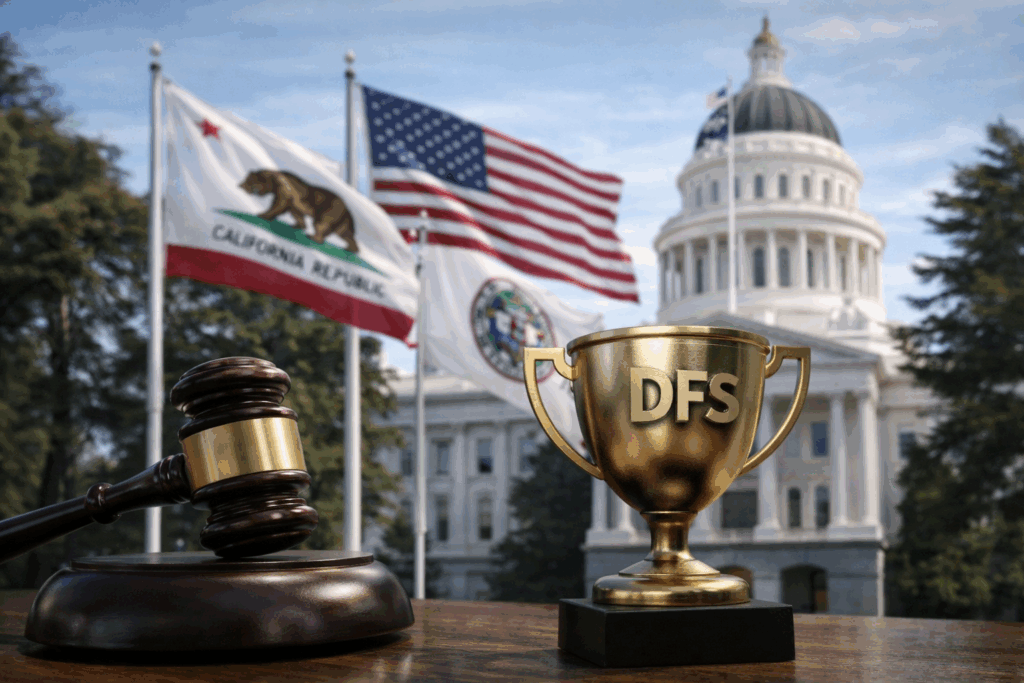
2026 update: California’s daily fantasy sports (DFS) market has shifted from a long-standing gray area into a period of legal and regulatory uncertainty following a formal opinion from the state’s attorney general.
While DFS operators continue to serve players, the risk profile has changed significantly, raising new questions about whether California will ultimately outlaw fantasy sports—or regulate them.
Will California Outlaw Fantasy Sports?
For years, DFS operated in California without explicit authorization or prohibition. Operators relied on the absence of enforcement, partnerships with professional sports teams, and industry arguments that fantasy sports are games of skill. That equilibrium was disrupted by the attorney general’s conclusion that DFS contests are illegal for players physically located in the state, forcing lawmakers, tribes, operators, and players to reassess what comes next.
Updated status after Opinion 23-1001 (what changed)
The most significant development came with the release of Opinion 23-1001, in which the California Department of Justice concluded that daily fantasy sports contests constitute illegal wagering under existing state law.
In its official California Department of Justice press release on daily fantasy sports legality, the DOJ stated that DFS involves paying consideration for the chance to win prizes based on uncertain sporting outcomes—meeting the definition of gambling under California Penal Code §337a. The full legal reasoning is outlined in the DFS legal opinion PDF (23-1001).
While the opinion does not itself ban DFS or create new law, it carries substantial weight. It provides a legal foundation for enforcement actions and has already influenced how regulators, payment processors, and partners view DFS activity in the state.
How California got here: the pre-opinion gray area
Before the opinion, DFS in California existed in an unlicensed but largely tolerated space. Operators argued that fantasy sports fell outside gambling laws, and several companies secured high-profile partnerships with professional teams such as the Giants, Padres, and Dodgers through PrizePicks.
At the same time, tribal governments consistently opposed DFS expansion, warning lawmakers that fantasy contests—especially pick’em formats—resembled unregulated sports betting. That opposition culminated in a joint tribal letter urging legislators to wait for guidance from the attorney general before taking action, a request that ultimately led to Opinion 23-1001.
The three possible paths from here
With the gray area effectively closed, California now faces three realistic paths forward for fantasy sports.
Legislation to authorize and license DFS Lawmakers could introduce legislation explicitly legalizing and regulating DFS, creating a licensing framework similar to other states. This would require navigating tribal exclusivity concerns and defining how DFS differs from sports betting.
Enforcement actions under existing law The state could move forward using current statutes, relying on the attorney general’s opinion to pursue enforcement. Bookmakers Review has detailed this scenario in its coverage of how the California attorney general is moving against DFS operators.
Continued litigation and uncertainty Operators may continue to challenge the opinion in court, delaying resolution. This path preserves uncertainty for players and businesses while the judiciary weighs in on the scope of the attorney general’s authority.
Where pick’em fits in the fight
Pick’em contests have become a focal point in the broader DFS debate. Unlike traditional draft-style contests, pick’em games ask users to predict whether individual athletes will exceed or fall short of specific statistical benchmarks—an approach critics say closely mirrors proposition betting.
Tribal governments have been especially vocal on this point, arguing pick’em products undermine California’s gaming framework. Those concerns are explored in coverage of how California tribes are aiming at DFS and pick’em contests.
Pick’em has also been central to operator pushback. Underdog Fantasy’s legal challenge to the attorney general’s opinion highlights how heavily some platforms rely on pick’em formats, a dispute detailed in the Underdog lawsuit over DFS legality in California
What this means for players and the market
For now, DFS remains available to many California players, but the risk of sudden changes has increased. Operators may restrict access, adjust offerings, or exit the state altogether depending on enforcement signals and court outcomes.
For ongoing updates on availability and legality, readers can follow developments in the California DFS and pick’em hub, as the state weighs whether to regulate, prohibit, or continue litigating the future of fantasy sports.
This article is for informational purposes only and does not constitute legal advice.