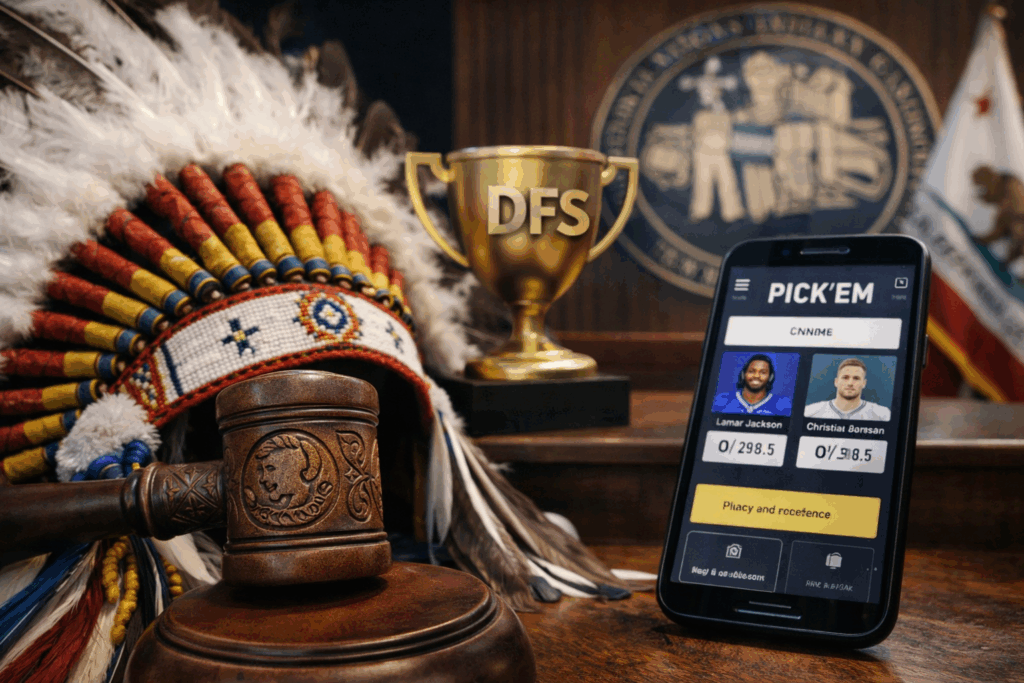
The daily fantasy sports (DFS) debate in California has intensified as Native American tribes formally urge state officials to scrutinize—and potentially act against—DFS and pick’em contests they argue resemble illegal sports betting. A letter submitted by the California Nations Indian Gaming Association (CNIGA) places renewed pressure on lawmakers and regulators at a time when the state is already reassessing DFS legality.
California Native American Tribes Take Aim at DFS and Pick’em Operators
For years, DFS operated in California without explicit authorization, relying on a lack of enforcement and industry arguments that fantasy contests are games of skill. Tribal governments, however, have consistently warned that newer pick’em-style games cross a regulatory line, threatening tribal gaming exclusivity and consumer protections embedded in California law.
What CNIGA is asking for
In its letter to state officials, CNIGA asks California regulators to closely examine whether DFS and pick’em contests violate existing gambling statutes. Rather than calling for immediate legislative action, the tribes urge the state to prioritize enforcement consistency and avoid allowing betting-like products to operate outside the tribal gaming framework. CNIGA leadership emphasized that voter-approved tribal exclusivity and tribal-state compacts should not be undermined by unregulated digital wagering products.
The letter was submitted as part of a broader stakeholder feedback process initiated by the attorney general, signaling that tribal governments expect their concerns to carry significant weight as California determines how to proceed.
Pick’em vs “classic fantasy” (why regulators care)
A central issue raised by tribes is the distinction between traditional fantasy sports and pick’em contests.
Classic fantasy games typically involve drafting a roster of athletes and competing against other players based on cumulative statistical performance. Operators argue these contests are peer-to-peer and skill-based, separating them from gambling.
Pick’em contests, by contrast, ask players to predict whether individual athletes will go over or under statistical benchmarks. Multiple selections are often combined into a single entry, closely resembling parlay wagers. CNIGA argues that in these formats, players are effectively competing against the operator, the “house”. rather than against one another.
This distinction matters to regulators because games that function like proposition betting may fall squarely under gambling laws. Tribal leaders also point to actions taken in other states against pick’em operators as precedent for why California should not treat these products as lawful fantasy sports.
How this intersects with the 2025 DOJ opinion (23-1001)
The reasoning, detailed in the DFS legal opinion PDF (23-1001), found no meaningful legal distinction between draft-style DFS and pick’em formats. Both were determined to involve consideration, chance, and prizes tied to real-world sporting events—meeting the definition of wagering under California law.
That conclusion directly supports tribal arguments and helps explain why CNIGA intensified its advocacy following the opinion’s release.
How tribal pressure fits into California’s broader DFS debate
Tribal opposition now intersects with increased enforcement risk and ongoing litigation involving DFS operators. Bookmakers Review has examined this shift in detail in its coverage of how the California attorney general is moving against DFS operators.
Operators have pushed back. Underdog Fantasy, for example, filed suit challenging the attorney general’s authority to issue the opinion, a dispute outlined in coverage of the Underdog lawsuit over DFS legality in California.
At the same time, lawmakers face pressure to decide whether California should regulate DFS or prohibit it altogether. That broader policy debate is explored in Bookmakers Review’s background analysis on whether California will outlaw fantasy sports.
What this means for players and the market
For now, DFS and pick’em contests remain available to many California players, but tribal advocacy adds another layer of uncertainty. Operators may scale back offerings, restrict access, or reconsider partnerships depending on enforcement signals.
Ongoing updates on legality and availability are tracked in the California DFS and pick’em hub, as tribal pressure, enforcement discussions, and legal challenges continue to shape the future of fantasy sports in the state.
This article is for informational purposes only and does not constitute legal advice.