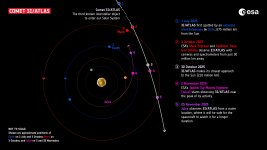
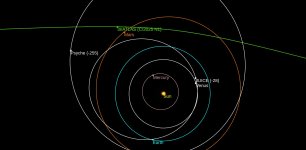
Oddities about 3I/ATLAS - our current extra-solar (outside the solar system) visitor:
1. The presence of nickel: the detection of nickel (specifically atomic nickel vapor, denoted as Ni I emission lines). Nickel is a heavy metal with a high sublimation temperature—around 1,500–2,000 K for pure nickel under vacuum conditions—far hotter than the ambient temperatures at 3–4 AU (where equilibrium blackbody temperatures are only ~140–170 K). For nickel to appear as atomic gas in the coma at these distances, it can't be from simple thermal sublimation of typical metal or sulfide phases (like those in meteorites).
2. The absence of iron: in natural cosmic materials, iron (Fe) and nickel (Ni) are almost always found together because they are produced simultaneously in supernova explosions. If a comet releases metals into its coma, you'd expect both Fe I and Ni I emission lines in spectra. However, in 3I/ATLAS, numerous Ni I lines were detected, but Fe I emissions were completely absent (undetected even at sensitive limits). Such a separation doesn't occur naturally in astrophysical environments but is a hallmark of industrial processes on Earth, like the Mond process, which uses carbon monoxide to form volatile nickel carbonyl (Ni(CO)₄) for purifying nickel from iron-rich ores.
3. Outgassing mixture: the coma's gas is dominated by CO2 (95%) with minimal H2O (5%), unlike typical solar system comets that are water-rich. No significant OH (from water) or other common volatiles like C₂, C₃, or NH₂ were detected at larger distances. Combined with atomic nickel vapor and cyanide (CN) emissions and steep production rate increases, it suggests non-natural mechanisms.
4. 3I/ATLAS is anomalously massive: recent measurements using Hubble and other telescopes estimate the comet's nucleus at about 3–5 miles (5–8 km) in diameter but with a mass exceeding 33 billion tons. This is potentially 100,000 times more massive than previously observed interstellar objects.
5. It has a highly improbable trajectory and planetary alignments: the object's path is retrograde (opposite to most solar system bodies), steeply inclined, and aligns within 5° of Earth's ecliptic plane—a random probability of about 0.2% (1 in 500). It also performs close flybys of Mars and Jupiter in quick succession, with a combined random chance estimated at less than 0.005% (1 in 20,000). Its speed (~60 km/s or 134,000 mph) and timing place its closest solar approach (perihelion on Oct. 29, 2025) directly behind the Sun from Earth's view, creating a "blind spot" for observation.
6. It lacks a prominent cometary tail: 3I/ATLAS shows minimal visible tail or coma despite brightening as it approaches the Sun, with outgassing dominated by CO2 (95%) and minimal water (5%). No strong evidence of volatile ices sublimating, which is odd for a natural comet at these distances.
7. The polarization is odd: recent measurements show polarization levels that "break the rulebook" for comets, with unusual glows, metallic "smelting" signatures, and harmonic pulses (e.g., every 1,014 seconds or ~17 minutes). Radio signals (e.g., 0.05 Hz Doppler at 437 MHz) have been speculated as non-random, though this speculation is unconfirmed.
Observation capabilities in Martian orbit: The following Mars Orbiters are in place to observe 3I/Atlas:
1. NASA's Mars Reconnaissance Orbiter (MRO) to observe 3I/ATLAS between 1–4 a.m. UTC on October 2nd.
2. ESA's Mars Express to observe Oct. 3rd.
3. ESA/Roscosmos ExoMars Trace Gas Orbiter (TGO) to observe Oct. 3rd.
The following 4 may also provide information:
4. NASA's MAVEN (Mars Atmosphere and Volatile Evolution)
5. UAE's Emirates Mars Mission (Hope Probe)
6. China's Tianwen-1 Orbiter, and
7. NASA's Mars Odyssey with the Thermal Emission Imaging System (THEMIS).
Observation capabilities in Jupiter orbit: NASA's Juno spacecraft, which has been in a polar orbit around Jupiter since 2016, could potentially capture images or spectra of the interstellar comet 3I/ATLAS. Closest date of approach to Jupiter is March 16, 2026.
Instruments on board:
1. JunoCam: A visible-light camera capable of taking color images of Jupiter's atmosphere, moons, and other solar system objects. It has previously imaged distant targets like Earth's moon and has the resolution (up to ~3 km/pixel at Jupiter's distance) to detect the comet's coma and tail.
2. Juno-UVS (Ultraviolet Spectrograph): A far-ultraviolet imaging spectrograph that can capture spectral images of gas emissions (e.g., H, OH, CO) in the comet's coma and tail, providing compositional data rather than pure photographs.
3. JIRAM (Jovian Infrared Auroral Mapper): An infrared imager/spectrometer that could detect thermal emissions or dust in the comet's envelope.
Another space probe which may capture information is the Jupiter Icy Moons Explorer (JUICE). It is a European Space Agency (ESA) mission designed to study Jupiter and its three largest icy moons—Ganymede, Callisto, and Europa—with a focus on their potential habitability and subsurface oceans.
Launched on April 14, 2023, from Kourou, French Guiana, aboard an Ariane 5 rocket, JUICE is currently en route to Jupiter, where it will arrive in July 2031. But on its way to Jupiter, on November 4, 2025, JUICE will pass within ~0.43 AU (~64 million km or 40 million miles) of 3I/ATLAS, as the comet approaches its perihelion (October 29, 2025).
The flyby occurs shortly after the comet’s closest approach to the Sun, when its activity (outgassing of CO₂, nickel, and cyanide) is near peak, potentially producing a bright coma and tail (magnitude ~8–10). JUICE’s position avoids the solar conjunction blackout (October 11–30, 2025) that limits Earth-based observations, providing a complementary perspective.
JUICE’s UVS and MAJIS (spectrographs) can probe the comet’s coma for metallic or organic signatures, potentially confirming or refuting exotic chemistry (e.g., nickel carbonyls). JANUS images could reveal structural anomalies, like the “teardrop-shaped dust cocoon” seen by Hubble.