Skip to content

Advances In AI & Other Technology

Wagerallsports

Wagerallsports

Joined
Mar 6, 2018
Messages
84,608
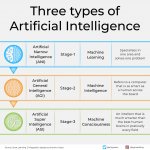
The Three Stages of AI
  • 1. Artificial Narrow Intelligence (ANI / Weak AI):
    • Definition: Systems designed to perform specific tasks within a limited context (e.g., facial recognition, recommendation algorithms, chatbots).
    • Current Status: All current AI is considered Narrow AI.
    • Examples: Apple Siri, Google Search, Tesla self-driving features, and Chess engines.
  • 2. Artificial General Intelligence (AGI / Strong AI):
    • Definition: AI that possesses the ability to understand, learn, and apply knowledge across a wide variety of tasks at a human-level, including reasoning and adaptability.
    • Current Status: Theoretical; not yet achieved.
  • 3. Artificial Superintelligence (ASI):
    • Definition: A hypothetical form of AI that surpasses human intelligence and capability in virtually every field, including creativity, wisdom, and social skills.
    • Current Status: Theoretical.
 

Wagerallsports

Wagerallsports

Joined
Mar 6, 2018
Messages
84,608
Oracle just told every AI company on earth the same thing.

Your models are worthless.

Not the technology, talent or the billions spent training them.

But the data they were trained on.

Larry Ellison, the man who built Oracle into the backbone of global enterprise just dropped a bombshell.

He said ChatGPT, Gemini, Grok, and Llama, all of them are training on the exact same data.

The entire public internet, every Wikipedia page, Reddit thread and every news article.

That means they're all converging essentially becoming the same product with different logos.

Ellison's word for it is commodities.

But here's where it gets dangerous.

He says the real gold isn't public data, It's private data.

The medical records in hospital systems, the financial data in bank vaults.

The supply chain secrets of every Fortune 500 and guess where most of that data already lives.

Not Google, Amazon or Microsoft but inside Oracle.

Oracle databases hold most of the world's high value private enterprise data.
So Oracle just launched something called AI Database 26ai.

It lets the top AI models, ChatGPT, Gemini, Grok, Llama reason directly over a company's private data, without that data ever leaving the vault.

They're using a technique called RAG, Retrieval Augmented Generation.

The AI doesn't train on your data, it searches it in real time.

Think about what that means.

A bank could ask AI to analyze every loan it's ever made without exposing a single customer record.

A hospital could have AI diagnose patients using its full medical history without violating HIPAA.

A defense contractor could let AI reason across classified operations without data leaving a secure environment.

Ellison is betting this is bigger than the training market. Bigger than the GPU boom.

Bigger than the data center buildout.

He called it the largest and fastest growing market in history.

The numbers back the ambition.

Oracle's remaining performance obligations just hit $523 billion.

That's contracted revenue not yet delivered and $300 billion of it comes from OpenAI alone.

Cloud revenue hit $8 billion in a single quarter, OCI grew 66 percent and GPU revenue surged 177 percent.

But here's the part nobody's talking about.

If private data becomes the real AI moat, then whoever controls the database controls the future of AI.

And that's a level of power that should make everyone uncomfortable.


Wagerallsports

Wagerallsports

Joined
Mar 6, 2018
Messages
84,608
We’re spending $200B+ a year on data centers to power AI. One company raised $11M, grew human brain cells on a chip, and the cells taught themselves to play a 3D shooter in a week.

Cortical Labs grew 200,000 human neurons on a silicon chip and taught them to play Doom. The cells navigate, target enemies, and fire weapons in real time. Their previous game, Pong, took 18 months on older hardware. Doom took a week. An independent developer with zero biotech experience built the integration using a Python API. The neurons did the rest.

That compression from 18 months to one week tells you everything about where this is going.

Here’s what the “can it run Doom” crowd is missing: each CL1 unit costs $35,000. A full 30-unit server rack draws 850 to 1,000 watts total. Your brain runs on 20 watts. A single GPU cluster training an LLM can draw megawatts. The energy economics of biological compute are orders of magnitude better than silicon, and that gap scales.

The investor list tells you who’s paying attention. Horizons Ventures, Blackbird, and In-Q-Tel, the CIA’s venture arm. In-Q-Tel doesn’t fund science projects. They fund intelligence infrastructure. 115 units started shipping in 2025.

Cortical Labs is now selling “Wetware-as-a-Service” through the Cortical Cloud. Developers can deploy code to living neurons remotely without touching a lab. They’re pricing access at the level of a software subscription while the hardware runs on real human brain cells derived from adult skin and blood samples.

The Doom demo is marketing. The platform play is a bet that biological neurons will eventually outperform silicon at exactly the tasks AI struggles with most: real-time adaptation under uncertainty, learning from minimal data, and processing ambiguity without brute-force compute.

The question was never “can it run Doom.” The question is what happens when it can run everything else.


Wagerallsports

Wagerallsports

Joined
Mar 6, 2018
Messages
84,608
Stop scrolling. This is important.

In the last 24 hours:

> ChatGPT pretended to be a lawyer and destroyed a woman's legal case.

> Anthropic hired a therapist for their AI's anxiety

> OpenAI's head of Robotics quit because they're building autonomous kill systems with no human oversight

> Replit's CEO said being brainrotted is now a job qualification

> Scientists brought dead brain cells back to life in a petri dish and taught them to play DOOM

This isnt even the future, This is TODAY. One single day.

We're giving therapy to code, weapons to chatbots, law degrees to hallucinations, job offers to doomscrollers, and video games to the dead.

2026 is not real.


Wagerallsports

Wagerallsports

Joined
Mar 6, 2018
Messages
84,608
Rutgers University scientist Thierry Besançon just proved lasers can zap weeds as effectively as herbicides—without a single chemical!

In the first peer-reviewed East Coast trials (published June 2025 in Pest Management Science), Carbon Robotics' AI-guided LaserWeeder matched (or beat) conventional herbicides on spinach, peas, and beets.

Key wins:

- Pinpoint precision — zaps weeds 0.5 cm from crop seedlings with zero damage to the crop

- Up to 97% weed biomass reduction in tests
Better crop growth in some cases

- No herbicides = safer for workers, consumers, environment, and sidesteps resistant superweeds like Palmer amaranth

Besançon: "It’s pure physics. Just light energy targeting the weeds." Farmers with specialty crops (few herbicide options) are already interested.

Challenges: High cost (~$500K+), needs multiple passes, works best on small weeds—but tech is evolving fast (faster models coming).

This could revolutionize sustainable farming on the East Coast and beyond. No more "Roundup-ready" dependency?

What do you think—laser weeders the future, or too expensive/practical yet?


Top