
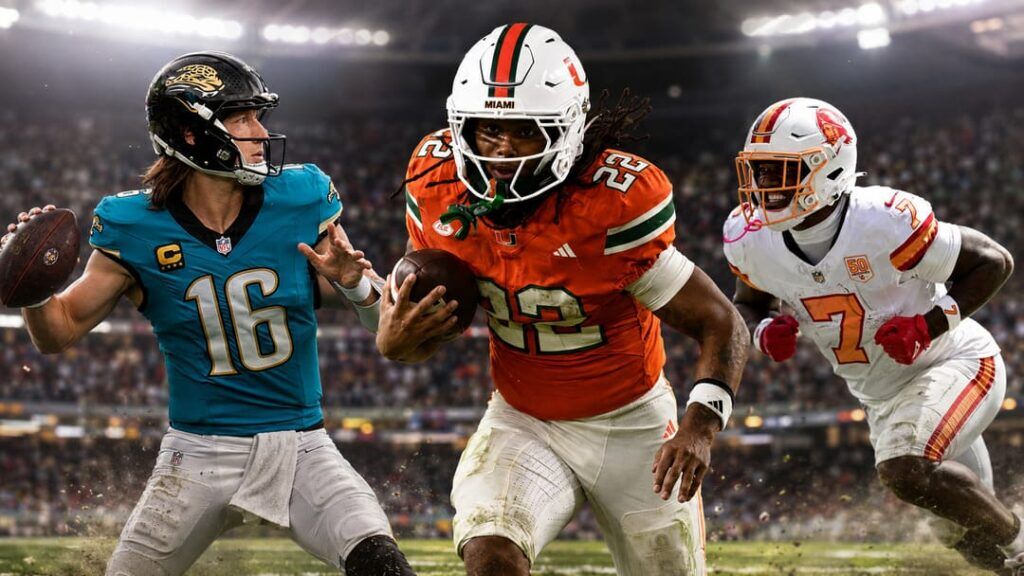
Florida football rarely belongs to one team for long. Miami can own the conversation in September, Florida State can flip the state with one rivalry win, Florida can change its entire mood with a fast start in The Swamp, and the NFL trio can take over the fall by Thanksgiving.
That is what makes 2026 so interesting. This is not just one football market. It is a state with three major college brands, three NFL teams, multiple rising programs, and year-round recruiting pressure. That is why this first Power Index works as a statewide reset for the Florida Football Insiders coverage hub, where BMR is rebuilding a broader home for Sunshine State football analysis.
The Hurricanes are trying to prove they can stay near the top after a national-title push. The Gators are entering a new era with an SEC schedule that offers very little breathing room. The Seminoles have a slate that can restore credibility or expose more rebuilding pain. The Jaguars are stepping onto a national and international stage. The Dolphins are trying to redefine themselves. The Buccaneers are still fighting to keep their NFC relevance alive.
So this is the Florida Football Insiders 2026 Power Index: a statewide look at the teams, schedules, pressure points, and storylines that will define football in the Sunshine State before camp begins.
Florida Football Insiders 2026 Power Index
This ranking is not only about who has the best roster today. It weighs ceiling, pressure, schedule difficulty, statewide relevance, and how much each team can change the Florida football conversation in 2026.
| Rank | Team | 2026 Storyline | Pressure Level |
|---|---|---|---|
| 1 | Miami Hurricanes | Can they turn a national-title run into staying power? | Very High |
| 2 | Jacksonville Jaguars | National TV, international games, and playoff-caliber tests | High |
| 3 | Tampa Bay Buccaneers | Can they keep the NFC South window open? | High |
| 4 | Florida State Seminoles | Schedule strength and program reset test | Very High |
| 5 | Florida Gators | New-era proof under a nine-game SEC format | Very High |
| 6 | Miami Dolphins | Identity reset after major change | High |
| 7 | UCF Knights | Big 12 relevance check | Medium |
| 8 | USF Bulls | Program momentum and state recruiting relevance | Medium |
| 9 | FAU Owls | Can they become more than a spoiler? | Medium |
| 10 | FIU Panthers | Development and identity-building year | Medium |
Miami starts at No. 1 because the Hurricanes have the clearest championship-adjacent profile in the state. That does not make them safe. It makes them the team with the most to defend. Their Hurricanes 2026 Preview already frames the season around sustaining elite status rather than simply proving The U is relevant again.
Jacksonville earns the No. 2 spot because the Jaguars may have the cleanest NFL upside in Florida. The franchise is no longer just chasing respect. It is trying to convert roster growth, quarterback development, national exposure, and a playoff-caliber schedule into a real AFC push.
Tampa Bay sits ahead of Florida State and Florida because stability still matters. The Buccaneers may not carry the same emotional volatility as the college programs, but their NFC South position gives them a clearer path to immediate relevance.
The College Big Three Pressure Check
Miami’s pressure is different from Florida’s and Florida State’s. The Hurricanes are no longer selling hope. They are selling continuity. Opening at Stanford gives Miami an immediate travel and focus test, while games against Florida State, Clemson, and Notre Dame will tell analysts whether this is a true playoff-level program or a team still learning how to carry expectations.
Florida’s pressure is more foundational. The Jon Sumrall era begins with the kind of schedule that does not allow a long runway. FAU offers an in-state opener with trap-game optics, Auburn introduces SEC road pressure, Georgia remains the measuring stick, and the Florida State finale can reshape the entire offseason narrative.
For the Gators, 2026 is not only about wins. It is about proof of direction. Florida does not need to look fully rebuilt by September, but it does need to look organized, physical, and capable of surviving the weekly strain of a tougher SEC format.
Florida State might have the most volatile profile in the state. Alabama, Miami, Clemson, and Florida are not just games. They are reputation checkpoints. A strong run through that slate would restore national credibility quickly. A rough one would make the reset feel longer and louder.
For bettors and analysts comparing college markets throughout the season, BMR college football odds will be useful because the Big Three will likely create weekly movement around spreads, totals, futures, and rivalry-game pricing.
The NFL Trio Has Its Own Statewide Argument
The Jaguars rank second overall because Jacksonville enters 2026 with the clearest NFL upside in the state. The franchise is no longer treated like a cute breakout story. It has playoff expectations, a quarterback-centered ceiling, and a schedule that includes national visibility.
The Jaguars 2026 Preview goes deeper on whether Trevor Lawrence and Jacksonville can turn promise into a true AFC push. That is the real question now. Jacksonville has moved beyond the “can they matter?” stage. The new question is whether they can matter in January.
Jacksonville also carries a unique wrinkle: international attention. The official NFL international games schedule gives the Jaguars a global-stage component that most Florida teams will not have. That matters for travel, preparation, branding, and how the team handles unusual scheduling pressure.
Tampa Bay sits third because the Buccaneers still have the most stable pro identity in the state. They may not have the same explosive “new contender” feeling as Jacksonville, but their NFC South positioning keeps them relevant. If the offense stays efficient and the defense holds up, Tampa Bay can remain in the playoff conversation deep into the season.
The Dolphins rank sixth because their reset creates more questions than answers. That does not mean Miami lacks talent. It means the 2026 season is about identity before certainty. The Dolphins 2026 Preview is the better place to go deeper on the leadership shift, roster transition, and what a successful first year should realistically look like.
For weekly pro football movement, BMR NFL odds will matter most when Florida’s three NFL teams hit high-volume windows: primetime games, division matchups, injury-heavy weeks, and late-season playoff races.
The Next Wave Still Matters
A true Florida power index cannot stop with Miami, Florida, Florida State, and the NFL teams. UCF, USF, FAU, and FIU help define the state’s football depth.
UCF has the highest ceiling of that next group because Big 12 relevance changes perception quickly. A strong conference start can make the Knights a weekly talking point again, especially in recruiting corridors where Florida’s Power Four programs constantly overlap.
USF’s case is about momentum. The Bulls do not need to win the state to matter. They need to keep building a program identity that attracts talent, produces exciting Saturdays, and makes Tampa Bay more than just an NFL-first football market.
FAU and FIU are in a different lane. Their seasons should be judged by development, competitiveness, and whether they can become dangerous enough to influence bowl races, recruiting conversations, and in-state scheduling decisions.
The next wave matters because Florida football depth is part of the state’s identity. The Sunshine State is not only measured by playoff contenders. It is also measured by whether its smaller programs keep producing storylines, players, and upset potential.
Games That Define Florida Football In 2026
These are the games that can move the Power Index fastest. Some will decide rivalries, some will shape playoff narratives, and some will reveal whether a program’s offseason optimism was real.
- Florida at Florida State: The biggest statewide temperature check. This game affects recruiting, fan confidence, coaching narratives, and the offseason mood for both programs.
- Florida State at Miami: A rivalry game with ACC weight. If Miami is chasing the playoff and Florida State is trying to reassert itself, this becomes a brand-control game.
- Florida at Auburn: A road SEC test that can show whether Florida’s new era has real structure or is still searching for week-to-week consistency.
- Florida vs. Georgia: The Gators’ measuring-stick game. Georgia remains the standard Florida must close on if the rebuild is going to feel serious.
- Miami at Stanford: A travel and focus test. Cross-country games can expose preparation issues before deeper roster questions even appear.
- Miami at Notre Dame: A national-stage credibility game. If Miami wants to be treated like a title contender again, this is the kind of matchup it must handle.
- Jaguars international games: A schedule-management test. International games create unusual travel, routine, and recovery questions for a team with AFC ambitions.
- Dolphins at Raiders Week 1: An immediate identity check. Miami’s reset will be judged quickly if the offense looks disjointed or the defense struggles on the road.
- Buccaneers early NFC tests: Tampa Bay’s first major conference games will show whether the Bucs are still a division threat or drifting toward transition.
The common thread is pressure. These games are not just schedule markers. They are perception games. They can change how fans, bettors, analysts, and recruiting observers talk about Florida football before the season reaches its midpoint.
What Bettors And Analysts Should Watch
The best way to follow Florida football in 2026 is not just to track wins and losses. The sharper read comes from watching the indicators that usually show up before the standings fully catch up.
- Quarterback stability: Uncertainty at quarterback can move weekly expectations faster than almost anything else, especially for Miami, Florida, Florida State, Jacksonville, and Miami’s NFL team.
- Offensive line continuity: Protection and run-game control will shape whether Florida’s biggest teams can survive high-leverage games.
- Travel spots: Miami at Stanford, Jacksonville abroad, and short-week NFL situations can affect rhythm, recovery, and market perception.
- Rivalry-game volatility: Florida-Florida State and Miami-Florida State rarely behave like clean projections. Emotion and recruiting stakes matter.
- Coaching changes: New systems often create early inconsistency, even when the long-term direction is positive.
- Bye-week placement: Rest advantage matters more when teams face physical league schedules, rivalry stretches, or back-to-back road games.
- Injury depth: Florida teams with strong second units can survive the season’s middle stretch better than teams relying on thin star power.
- Defensive front strength: The teams that control the line of scrimmage will be better positioned in rivalry games, SEC tests, and AFC/NFC playoff races.
- Early-season market overreactions: One impressive September win or one ugly opener should not define the whole year, especially with young rosters and new coaching structures.
Readers who want the broader betting context for in-state teams can use the Florida sports betting guide as a companion resource, especially when separating team analysis from legal access, market availability, and sportsbook selection.
For prediction-driven readers, BMR’s NFL picks and props page can also help frame weekly pro football angles once the Jaguars, Dolphins, and Buccaneers move from preseason questions into live matchups.
Final FFI Verdict
Florida’s 2026 football season is not about one team carrying the state. It is about which program can turn pressure into proof.
Miami starts the year with the highest ceiling. Jacksonville has the strongest NFL argument. Tampa Bay remains dangerous because stability still matters. Florida State and Florida both have seasons that could swing sharply depending on rivalry results and early schedule pressure. The Dolphins are rebuilding identity. UCF, USF, FAU, and FIU give the state needed depth.
That is exactly the kind of season Florida Football Insiders was built to cover: messy, layered, statewide, and impossible to reduce to one helmet.
The first Power Index is only the starting point. The real rankings will change when quarterbacks settle in, injuries hit, rivalries arrive, and pressure stops being theoretical.


